Proof boundaries
V1 showed output. HawkinsOperations shows controlled proof boundaries.
HawkinsOps V1 remains online as a historical archive of the original SOC automation and detection engineering work.
The current governed rebuild lives in the HawkinsOperations GitHub organization and on hawkinsoperations.com, where source, validation, platform contracts, proof records, governance routing, and public rendering are separated.
Single public proof surface, historical snapshot, original SOC automation work.
Six-repo governed system: source truth, validation truth, platform contracts, proof records, governance routing, public navigation.
Historical HawkinsOps V1 context only. These metrics are not current HawkinsOperations runtime proof, production proof, public-safe proof, customer deployment proof, or SOCaaS availability proof.
V1 showed output. HawkinsOperations shows controlled proof boundaries.
V1 bundled story and proof together. HawkinsOperations separates source, validation, platform, proof, governance, and rendering.
V1 was a closed snapshot. HawkinsOperations is the active governed system for review, validation, routing, and claim control.
Detection source lives in hawkinsoperations-detections.
Controlled validation lives in hawkinsoperations-validation.
Ledgers, case packets, and automation boundaries live in hawkinsoperations-platform.
Proof records and claim ceilings live in hawkinsoperations-proof.
Reviewer routes and authority maps live in .github.
hawkinsoperations.com renders reviewer paths, but does not create proof.
HawkinsOps V1 remains useful for historical context, prior artifacts, and the closed V1 proof surface, but it should not be treated as the active operating architecture. Website rendering is not proof. GitHub rendering is not runtime truth. Green CI is not final authority. AI is support labor, not final security authority.
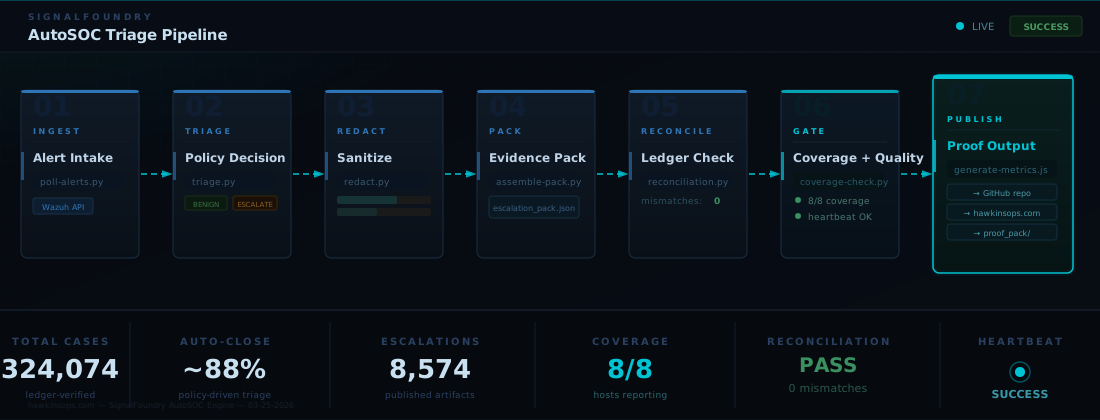
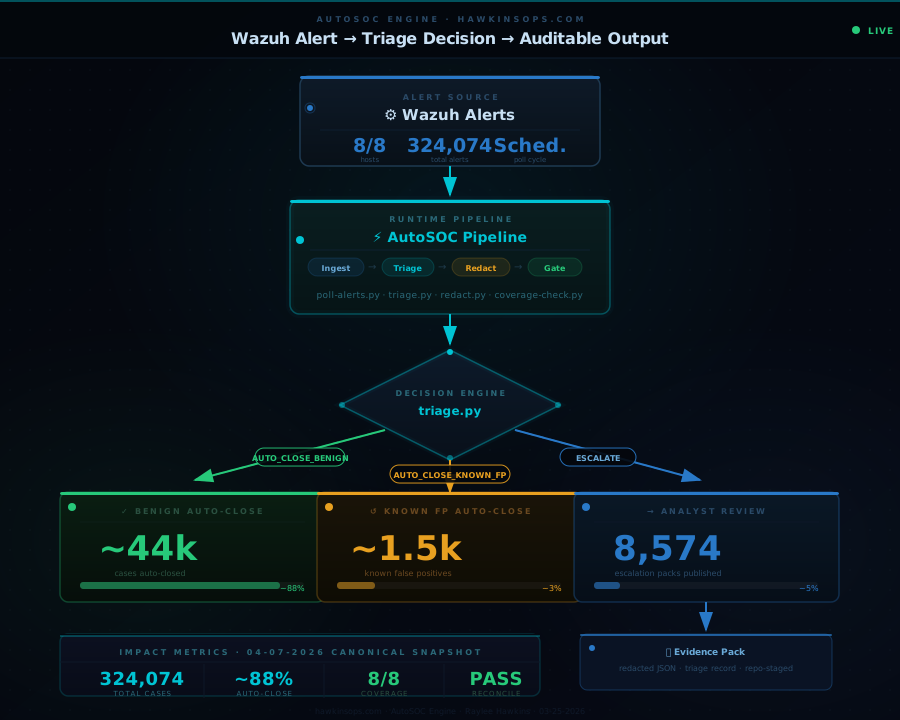
Wazuh alerts in → policy-driven triage → mandatory redaction → evidence packs → reconciliation gate → published proof. 35-script Python pipeline. Deterministic. Nothing publishes without PASS.
Every alert enters the same pipeline. Most are auto-closed. The rest produce structured evidence packs.
211 detection rules across 4 platforms, mapped to MITRE ATT&CK (+ 10 IR playbooks). Full searchable inventory →
MITRE-mapped behavioral detections across tactic folders: process creation, lateral movement, credential access, persistence, and more.
Custom rule IDs (100000+ range), deployed to Wazuh Manager. Lab-validated with detection harness.
7-step structured response: detect, triage (5 min), investigate (30 min), contain, eradicate, recover, document.
Investigation queries against Wazuh-forwarded events. Home lab scope — not enterprise deployment.
Locked snapshot from data/truth/current-authority.json. These values do not change from later telemetry. Full proof →
data/truth/current-authority.json.site/data/truth/current-authority.jsonPipeline health check.
All endpoints reporting.
Analyst-ready evidence packs.
0 mismatches between stages.
Snapshot date.
Source: /assets/data/ops-metrics.json · Locked: 04-21-2026 · Full verification →
Public benchmark snapshot · Runtime snapshot · Generated at 04-21-2026 · Source artifact /assets/data/ops-metrics.json
HawkinsOps is the closed V1 proof surface. HawkinsOperations is the successor governance architecture, split across detection, validation, platform, proof, and website repositories so source, runtime, signal, evidence, and public-proof claims do not collapse into one surface. RayleeOps carries public review/context. Website pages render approved claims; they do not create proof by themselves.
Every claim on this site traces back to a verification command. Clone the repo and run these:
Pipeline health check confirming SignalFoundry's triage loop completed its last scheduled run without errors. All 7 stages — ingest, triage, redact, pack, reconcile, gate, publish — must succeed.
data/truth/current-authority.json → metrics.heartbeat
SUCCESS = full pipeline pass within the verification window. FAIL = automatic hold on public metric updates until root cause is resolved. WARN = partial pass with non-blocking anomaly.
Ratio of monitored lab hosts that reported telemetry within the last verification window. Full coverage (8/8) means every endpoint in the lab environment submitted logs to the Wazuh manager.
| Host | Role | Status |
|---|---|---|
wazuh-mgr | SIEM Manager | Reporting |
dc01 | Domain Controller | Reporting |
win10-pc01 | Workstation (Sysmon) | Reporting |
win10-pc02 | Workstation (Sysmon) | Reporting |
linux-web | Web Server | Reporting |
linux-db | Database Server | Reporting |
honeypot | Honeypot Sensor | Reporting |
splunk-fwd | Splunk Forwarder (vm104) | Reporting |
data/truth/current-authority.json → metrics.coverage_ratio
Cases that exceeded benign auto-close thresholds and were escalated for human review or evidence pack assembly. These represent the non-trivial alerts that required analyst judgment.
Of 324,074 total cases processed, ~88% were automatically resolved through benign plus known-false-positive handling. The remaining cases produced 8,574 escalation artifacts for review.
data/truth/current-authority.json → metrics.stable_escalated
A high auto-close rate with meaningful escalation volume demonstrates that detection rules are tuned — not noisy, not over-suppressed. Each escalated case generates a structured evidence pack for review.
The date the public-facing metrics were locked from the V1 pipeline output. Once locked, these values remain stable for reviewer reference — they do not update from later telemetry.
Pipeline runs → output captured to source_of_truth/ → verified by scripts/verify/verify-counts.ps1 → promoted to data/truth/current-authority.json → deployed to public site. Subsequent pipeline runs do not overwrite locked values.
data/truth/current-authority.json → metrics.stable_locked_date